The Anatomy of Authority: Why a Single Saint Laurent Silhouette Has Become the Signature of America's Most Influential Women
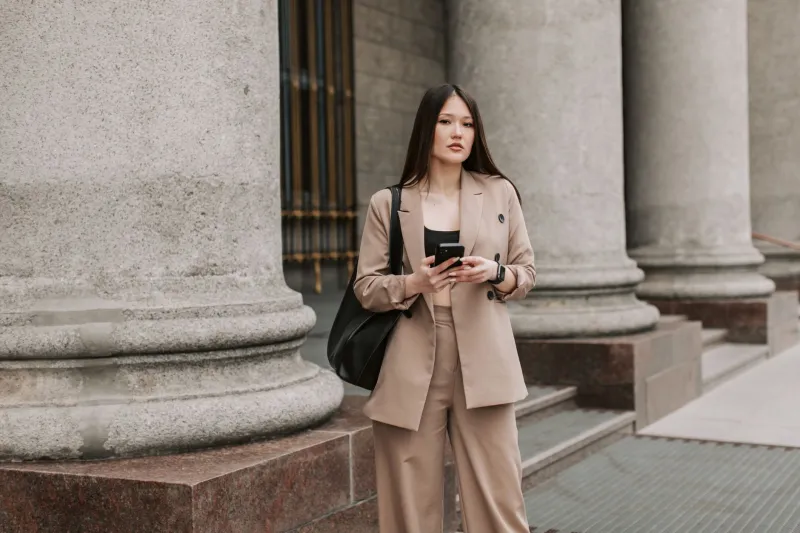
There is a particular grammar to the way powerful women dress. It is not loud. It is not performative. It operates, instead, through a series of deliberate, almost architectural choices—each piece selected not merely for its beauty, but for the precise message it sends without uttering a single word. Within that grammar, the handbag functions as punctuation: the final mark that determines the tone of everything that precedes it.
For a growing and remarkably consistent segment of American women in positions of significant influence—C-suite executives, venture capitalists reshaping Silicon Valley, media figures who shape national conversation—one Saint Laurent silhouette has emerged as the preferred punctuation mark. Not through a coordinated campaign or a celebrity endorsement cycle, but through something far more durable: genuine, repeated, independent selection by women who have both the means and the discernment to choose anything.
The question worth examining is not simply which bag they have chosen. It is why.
The Psychology of the Power Bag
Psychologists who study the relationship between material objects and identity have long noted that the accessories chosen by high-status individuals tend to share a set of defining characteristics: restraint in ornamentation, excellence in material, and a silhouette that reads as deliberate rather than decorative. The object, in other words, must project competence before it projects anything else.
Saint Laurent's design philosophy—particularly as it has evolved through the house's more recent creative direction—maps almost precisely onto those criteria. The brand's most enduring silhouettes favor clean geometric lines over embellishment, premium leathers that improve with handling rather than deteriorating under it, and proportions calibrated to function across an extraordinary range of professional and social contexts. These are not accidents of aesthetic preference. They are the result of a sustained design commitment to what might be called useful elegance: beauty that earns its place through performance.
For the woman carrying a Saint Laurent bag into a board meeting, a pitch presentation, or a network television studio, that design philosophy translates into something deeply practical. The bag does not compete with her presence. It reinforces it.
What Real Collectors Say
Conversations with women who have made a particular Saint Laurent silhouette their signature piece reveal a pattern of reasoning that is strikingly consistent across industries and geographies.
A managing director at a New York private equity firm described her decision in terms that had nothing to do with fashion: "I needed something that didn't require me to think about it. When you're walking into a room where you're already being assessed before you've spoken, the last thing you want is an accessory that raises questions. This bag answers them before they're asked."
A venture partner based in San Francisco offered a similar perspective, framed through the lens of signal efficiency: "In my world, ostentation is actually a negative signal. It suggests you're compensating for something. A bag that's clearly exceptional but doesn't announce itself—that's the signal I want to send. Saint Laurent does that better than almost anyone."
A network news anchor in Washington, D.C., who has carried the same Saint Laurent style for several years across both on-screen appearances and off-camera professional obligations, put it most succinctly: "It's the one thing I never have to reconsider. Everything else in my wardrobe rotates. This stays."
The phrase it stays recurred in nearly every conversation. It speaks to something beyond aesthetic preference—to a kind of trust that develops between a woman and an object that has proven itself across enough high-stakes moments to become genuinely indispensable.
The Design Philosophy Behind the Authority
To understand why Saint Laurent's silhouettes lend themselves so naturally to this role, it is worth returning to the house's foundational design principles. Yves Saint Laurent himself was famously preoccupied with the idea of clothing—and by extension, accessories—as instruments of female empowerment. His introduction of the women's tuxedo in the late 1960s was not merely a fashion statement; it was a philosophical one, asserting that women deserved garments that projected the same authority as their male counterparts.
That philosophy has never fully left the house. The handbags that have become synonymous with Saint Laurent's identity share its DNA: structured enough to project discipline, refined enough to project taste, and understated enough to avoid the kind of conspicuous consumption that, in many professional environments, reads as a lapse in judgment rather than a mark of success.
The hardware is considered but not excessive. The leather is selected for longevity as much as appearance. The proportions are versatile without being shapeless. Every decision reflects a design intelligence that understands its audience: women who have earned the right to demand excellence and are sophisticated enough to recognize it when it doesn't announce itself.
The Quiet Luxury Alignment
The rise of what American fashion observers have termed quiet luxury—a sensibility that prizes understated quality over visible branding—has brought Saint Laurent's design philosophy into particularly sharp cultural relief. In a marketplace crowded with maximalist statements and logo-saturated accessories, the house's commitment to restraint has come to feel not merely stylish but almost countercultural.
For influential women, this alignment is significant. The quiet luxury aesthetic maps cleanly onto the values that tend to define serious professional credibility in the United States: substance over spectacle, longevity over novelty, earned authority over borrowed status. A Saint Laurent bag, in this context, is not simply an accessory. It is a form of self-presentation that communicates, to anyone fluent in the language, that its owner has nothing to prove.
That is, ultimately, the most powerful signal of all.
Why One Bag Becomes a Uniform
The transition from a bag I love to the bag I always reach for is one that most serious collectors will recognize. It is not simply a matter of preference—it is a matter of trust. The bag that earns that designation has demonstrated, across countless real-world tests, that it will not fail you: not in its structure, not in its material, not in the impression it creates.
For the women who have made a Saint Laurent silhouette their professional uniform, that trust has been built incrementally, through years of consistent performance. The bag has traveled. It has sat in first-class overhead compartments and on the floors of venture-funded conference rooms. It has appeared in photographs that circulate widely and in meetings that no camera has ever captured. In every context, it has delivered.
That is the quiet achievement of great design: not to dazzle, but to endure. Not to demand attention, but to reward it when it comes. Saint Laurent, at its most considered, understands this distinction with unusual clarity—and it is precisely that understanding that has made one of its silhouettes the unofficial uniform of the women who are, in their own quiet way, running things.
For the collector considering her next acquisition, or the professional building a wardrobe designed to carry her through the next decade of her career, that distinction is worth understanding. The right Saint Laurent bag does not simply complete an outfit. It completes an argument—the one you've been making, through your work and your choices and your presence, all along.