Less Is More: The Hidden Power of Saint Laurent's Restrained Hardware Philosophy
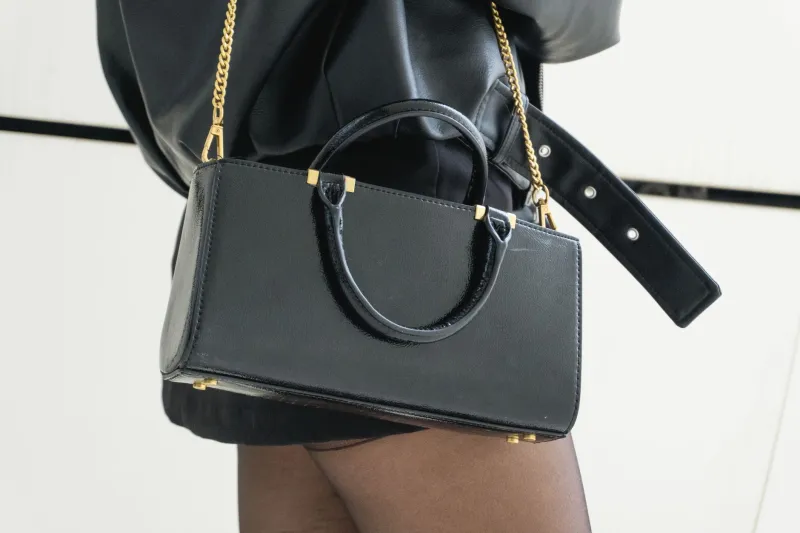
There is a particular kind of confidence that requires no announcement. It does not glitter unnecessarily, nor does it demand attention through excess. It simply exists — precise, considered, and entirely assured of its own worth. This is the philosophy that governs Saint Laurent's approach to hardware, and it is reshaping what American collectors understand luxury handbag design to mean.
While certain competitors have long relied on oversized logos, gilded clasps, and heavily embellished chain straps to signal prestige, Saint Laurent has pursued an altogether different strategy. The result is not merely a design aesthetic but a cultural statement — one that an increasingly sophisticated American audience has come to recognize as the truest expression of modern luxury.
The Architecture of Restraint
To understand Saint Laurent's hardware philosophy, one must first appreciate that restraint is not the same as simplicity. Every clasp, every chain link, every metal ring on a Saint Laurent handbag is the product of deliberate engineering. The brand's signature turnlock closures, for instance, are calibrated for a specific tactile resistance — firm enough to communicate security, smooth enough to suggest effortlessness. This balance is not accidental.
Chain straps, a defining element across several of the house's most celebrated silhouettes, are weighted with uncommon intentionality. Too light, and the bag loses its sense of substance; too heavy, and it becomes an imposition rather than an accessory. Saint Laurent's chains occupy a precise middle register — substantial without being burdensome, present without being performative.
The metal finishes themselves — typically rendered in aged gold, brushed silver, or oxidized brass — are chosen to evolve alongside the leather rather than compete with it. This is a crucial distinction. Where some houses treat hardware as the focal point, Saint Laurent positions it as a supporting element, one that enhances the overall composition without overpowering it.
Why American Collectors Are Taking Notice
The American luxury market has undergone a meaningful cultural shift over the past decade. The visible logomania that defined early-2000s aspirational fashion has given way to a more considered sensibility, particularly among high-net-worth consumers in cities such as New York, Los Angeles, Chicago, and Washington, D.C. These buyers are not simply purchasing status symbols — they are curating identities.
In this context, Saint Laurent's hardware philosophy resonates deeply. The understated clasp on a Lou camera bag or the refined chain of a Solferino communicates something that an oversized branded medallion cannot: the wearer already knows. There is no need to broadcast the acquisition because the acquisition itself is not the point. The point is the object's integrity, its longevity, and the quiet authority it lends to every environment it enters.
This shift has been noted across the broader accessories industry. Competing houses have begun recalibrating their own hardware programs in response, scaling back ornamentation in favor of more architectural, less declarative metalwork. The influence of Saint Laurent's approach is not incidental — it is directional.
The Technical Conversation Behind the Aesthetic
For collectors who engage with Saint Laurent at a deeper level, the hardware discussion extends well beyond visual preference into genuine material science. The alloys used in the brand's metal components are selected not only for their appearance but for their durability and resistance to tarnishing under regular use conditions. This matters considerably for collectors who view their acquisitions as long-term investments rather than seasonal indulgences.
The plating processes applied to Saint Laurent's hardware are also worth examining. The brand's aged gold finish, in particular, is achieved through a layering technique that produces a depth of tone absent from simpler electroplating methods. Over time, this finish develops a patina that complements rather than detracts from the bag's overall character — a quality that distinguishes a well-maintained Saint Laurent piece from one that has simply aged.
Clasp mechanisms, meanwhile, are engineered for thousands of open-and-close cycles without degradation of tension or alignment. For everyday carriers, this level of mechanical reliability is not a luxury — it is a necessity. Saint Laurent's hardware delivers on this expectation without drawing attention to itself, which is perhaps the most sophisticated achievement of all.
Contrasting Philosophies in the Luxury Landscape
To fully appreciate Saint Laurent's position, it is instructive to consider the broader competitive landscape. Houses such as Versace and Valentino have historically embraced hardware as a canvas for brand expression — medusa heads, V-shaped clasps, and logo-engraved chain links serve as unmistakable identifiers. This approach has its own integrity and its own devoted audience.
Other heritage houses, including certain Italian and French competitors, have navigated a middle path — retaining branded hardware elements while moderating their scale. Chanel's interlocking CC clasps and Louis Vuitton's LV-stamped padlocks occupy this territory: recognizable without being excessive, branded without being overwhelming.
Saint Laurent sits at the far end of this spectrum, where identification is achieved not through marking but through form. The hardware does not announce the house; the house announces itself through the totality of the object. For collectors who have moved beyond the acquisition phase and into genuine connoisseurship, this distinction carries considerable weight.
The Influence on Emerging Designers
Perhaps the most telling indicator of Saint Laurent's impact is the degree to which its hardware philosophy has begun to surface in the work of emerging American designers. A new generation of accessories labels — many of them founded by designers who trained at or were deeply influenced by European luxury houses — are adopting similarly restrained metalwork programs. The vocabulary of quiet hardware: the muted finish, the precision clasp, the weighted chain — is becoming a shared design language among those who aspire to the upper registers of the American accessories market.
This diffusion of influence speaks to something larger than trend. It suggests that Saint Laurent's approach has achieved the rare status of a design principle — a way of thinking about objects that transcends any single season or silhouette.
A Standard That Endures
In the cyclical world of fashion, it is tempting to interpret any dominant aesthetic as temporary. Hardware trends, like hemlines and heel heights, have always moved. But there is reason to believe that the values underlying Saint Laurent's hardware philosophy — precision, durability, material honesty, and formal restraint — are not merely fashionable. They are, in the truest sense, classical.
For the American collector navigating an increasingly complex luxury landscape, this distinction offers a reliable compass. The bag that does not shout its own name, whose hardware serves the object rather than advertising it, whose construction reveals itself only to those who know how to look — this is the bag that endures. And in that endurance, it becomes something more than an accessory. It becomes a standard.