The Theater of Acquisition: Saint Laurent's Packaging Ritual and Its Place in the Age of Shared Experience
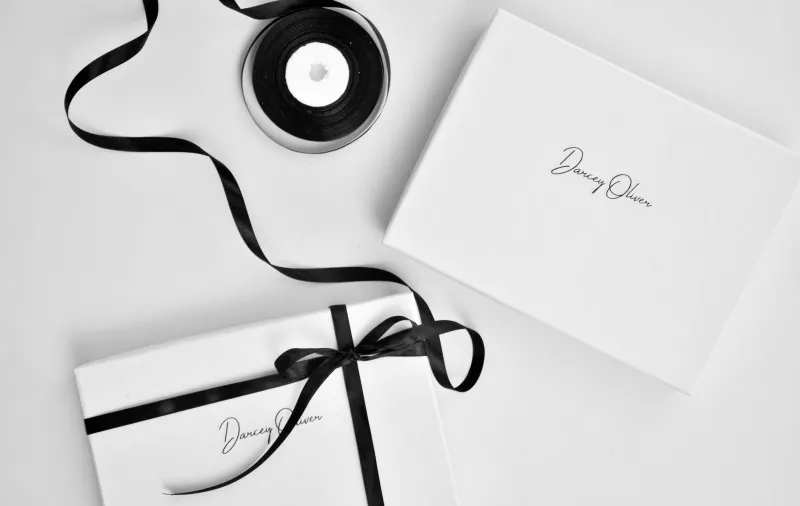
There is a moment, familiar to anyone who has received a Saint Laurent purchase, when the transaction ceases to be commercial and becomes ceremonial. The weight of the box. The resistance of the ribbon. The particular texture of the tissue paper as it yields to reveal what lies beneath. These details are not incidental. They are, in every meaningful sense, part of the product — and in an age when the act of receiving has become as publicly significant as the act of owning, they carry a cultural weight that the fashion industry is only beginning to fully reckon with.
Packaging as Brand Language
Saint Laurent's packaging is an extension of the house's design philosophy: rigorous, deliberate, and resistant to unnecessary ornamentation. The signature black boxes, the stark white tissue, the understated ribbon — each element has been selected not for extravagance but for coherence. The packaging does not shout. It affirms. And in the context of a luxury market increasingly saturated with maximalist presentations, that restraint reads as a form of supreme confidence.
This is not accidental. The house's creative direction has long understood that the container must be worthy of what it contains, and that worthiness is communicated through discipline rather than decoration. A Saint Laurent box, before it is opened, already tells the recipient something essential about the object inside: that it was made by people who take precision seriously, and that the experience of receiving it has been considered as carefully as the experience of wearing it.
The Ritual in a Social Media Context
For the past decade, the unboxing ritual has migrated from private experience to public performance with extraordinary speed. On YouTube, TikTok, and Instagram, luxury unboxing content commands viewership numbers that rival traditional fashion media. The format is deceptively simple — a camera, a purchase, a pair of hands — but the cultural function it serves is complex and worth examining seriously.
For American consumers between the ages of 25 and 45, who represent Saint Laurent's most digitally active demographic, the unboxing moment is simultaneously a personal ritual and a social communication. It declares taste, signals achievement, and invites a form of communal participation in a private experience. The comment sections beneath luxury unboxing videos are not merely spaces for admiration; they are forums for shared aspiration, in which viewers project themselves into the moment being documented.
Saint Laurent's packaging, in this context, is exceptionally well-suited to the medium. The high contrast of black box against white tissue translates beautifully on screen. The deliberate pace at which the packaging rewards investigation — outer ribbon, inner tissue, dust bag, the bag itself — creates a natural narrative arc that holds attention across the abbreviated attention spans of social platforms.
What the Moment Reveals About Modern Luxury Desire
The cultural prominence of the luxury unboxing raises a question that is, at its core, philosophical: has the experience of receiving luxury become as valuable as the experience of possessing it? The evidence suggests that for a significant segment of contemporary American luxury consumers, the answer is yes — or at least, that the two experiences are now inseparable.
This is not, it should be noted, a cheapening of luxury. It is a transformation of its social function. Where previous generations of luxury consumers derived satisfaction from the private knowledge of ownership, today's buyers are increasingly drawn to experiences that can be shared, documented, and returned to. The Saint Laurent unboxing video does not diminish the bag it reveals; it extends the moment of acquisition across time and social space, allowing the emotional charge of the purchase to be revisited and redistributed.
Behavioral economists who study luxury consumption have noted a corresponding shift in how consumers evaluate pre-purchase experiences. The quality of a brand's packaging, the elegance of its shopping bag, and even the atmosphere of its retail environment now factor into purchasing decisions in ways that were far less pronounced a generation ago. The unboxing is no longer an afterthought. It is a deliverable.
The In-Store Experience and Its Digital Afterlife
For those who acquire Saint Laurent pieces through the brand's American boutiques — in cities including New York, Los Angeles, Miami, Chicago, and San Francisco — the packaging ritual begins in the store itself. The deliberate presentation of the purchase, the care with which staff wrap and box each piece, and the moment of handing over the shopping bag all contribute to an experience that many buyers describe as meaningfully distinct from the transaction of purchasing.
This in-store theater has a documented digital afterlife. Buyers who document their boutique visits — the shopping bag carried through a city street, the box opened at home later — are extending the brand's visual presence into social spaces that no advertising budget can fully replicate. The authenticity of these personal documentations, precisely because they are not produced by the brand, carries a credibility that traditional marketing cannot manufacture.
Competing in the Experience Economy
Saint Laurent's packaging and presentation choices exist within a competitive landscape in which every major luxury house is investing in what the industry now calls "experiential differentiation" — the effort to make the act of purchasing as memorable and share-worthy as the product itself. In this context, the house's commitment to restraint is a strategic position as much as an aesthetic one.
In an environment where some competitors have leaned toward increasingly elaborate packaging — multiple boxes, elaborate ribbons, branded accessories tucked alongside the purchase — Saint Laurent's discipline communicates a confidence that resonates with a particular kind of American luxury consumer: one who has moved beyond the need for obvious signals and values the kind of quiet authority that does not require explanation.
The Ritual Endures
What the Saint Laurent unboxing moment ultimately reveals is something both simple and profound: that luxury, at its most genuine, is not merely about the object acquired but about the entire experience of acquiring it. The box, the ribbon, the tissue, the dust bag, and finally the bag itself — each stage of that revelation is a chapter in a story that today's consumers want to tell, share, and remember. Saint Laurent, with characteristic precision, has ensured that every chapter is worth the telling.