To Use or to Preserve: The Collector's Dilemma of Passing Down a Saint Laurent Handbag
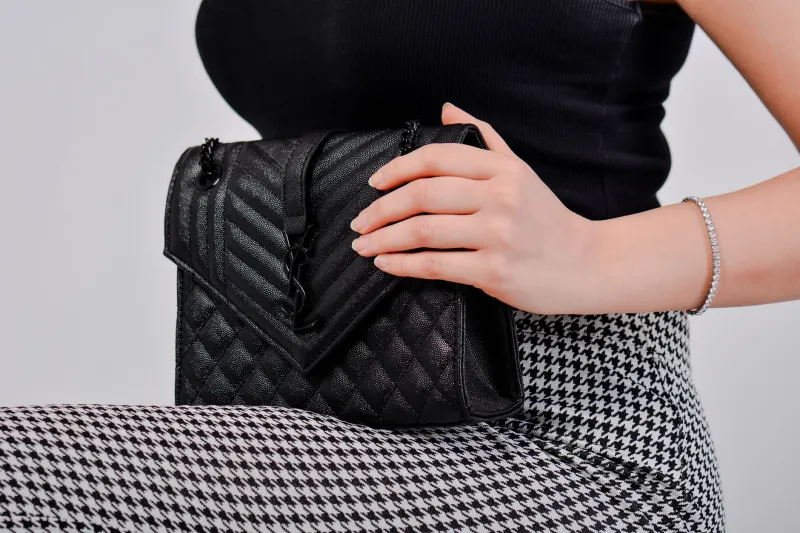
There is a particular kind of anxiety that arrives with owning something extraordinary. It settles quietly at the back of the mind the first time you set your Saint Laurent Sac de Jour on a restaurant banquette, or the moment a leather shoulder strap grazes the edge of a taxi door. The bag is magnificent. It is also, in some sense, mortal. And if you have begun to think of it as something worth passing down to the next generation, that anxiety sharpens considerably.
This is the heirloom paradox of the modern luxury collector: the very act of living with a Saint Laurent handbag—carrying it through the texture of a real American life—is precisely what makes it meaningful, and yet that same use is what most threatens the pristine condition that confers both financial and sentimental value.
The Mythology of the Untouched Object
American collectors have long maintained a complicated relationship with preservation. In other categories of collecting—fine art, vintage wine, first-edition books—the logic is straightforward: the less an object is handled, the more it is worth. Luxury handbags have, in recent decades, migrated toward that same philosophy. Auction houses and resale platforms consistently reward pieces accompanied by original receipts, dust bags, and hardware that has never met a key ring.
Saint Laurent, as a house, produces objects that invite this kind of reverence. The architectural geometry of the Kate clutch, the structural severity of the Icare tote, the sculptural refinement of the Le 5 à 7—these are not casual accessories. They carry the weight of the house's storied history, and many collectors treat them accordingly, rotating between pieces or reserving certain bags entirely for formal occasions.
Yet fashion historians are quick to note that Yves Saint Laurent himself never designed for inertia. His work was always in conversation with the body in motion—women who worked, traveled, and inhabited their clothes with full commitment. To freeze a Saint Laurent piece in amber, several scholars argue, is to misread the intention behind its creation entirely.
What Wear Actually Does to Value
The financial calculus here is more nuanced than it first appears. Condition, of course, remains the dominant variable in secondary market pricing. A Saint Laurent Loulou bag in excellent condition with original packaging will command a meaningfully higher price than an identical piece showing visible patina, softened corners, or hardware that has developed a gentle oxidized finish.
But the relationship between use and value is not uniformly negative. Certain collectors and resale specialists point to what might be called the provenance premium—the added dimension of documented ownership history that can, in rare cases, elevate a well-maintained but clearly carried piece above a pristine example with no story attached. This is particularly true when the original owner is a figure of cultural significance, though it applies in smaller measure to any bag whose history can be clearly traced and authenticated.
For most collectors, however, the practical reality is simpler: use introduces risk. Structural leather softens with humidity and body heat. Suede lining accumulates the invisible residue of daily life. Metal feet, however robust, will eventually show the evidence of hard floors. None of these outcomes are catastrophic, but each one is a small departure from the condition that maximizes the bag's future value—whether financial or familial.
The Emotional Architecture of Inheritance
Perhaps the more interesting question is not what wear does to a bag's market price, but what it does to its meaning as an heirloom. Conservators who specialize in luxury goods often observe that the objects most fiercely protected by families across generations are rarely the most pristine ones. They are the ones that carry evidence of a life.
A Saint Laurent Cabas Rive Gauche that accompanied its owner through a decade of professional milestones, that absorbed the particular scent of her perfume and the slight asymmetry of her daily carry, is a different object from the same bag sealed in its original packaging. One is an artifact. The other is a relic—and the distinction matters enormously to the person who will eventually receive it.
This is the dimension of the heirloom paradox that no spreadsheet can resolve. The daughter or niece who inherits a perfectly preserved, never-carried Saint Laurent bag receives something financially valuable and aesthetically intact. The one who inherits a bag with stories embedded in its grain receives something that cannot be replicated at any price.
Strategies for Navigating the Middle Ground
For collectors who refuse to choose between living with their Saint Laurent pieces and maintaining their long-term integrity, a set of practical strategies has emerged.
Intentional rotation remains the most common approach. Rather than designating a single bag as the everyday workhorse, serious collectors rotate among several pieces, ensuring that no single bag absorbs disproportionate wear. This extends the lifespan of each piece while allowing the collection as a whole to remain active and present in daily life.
Professional conditioning and storage represents another meaningful investment. Leather conservators with luxury goods experience recommend conditioning Saint Laurent's smooth calfskin and lambskin pieces seasonally, storing them stuffed with acid-free tissue in their original dust bags, and keeping them away from both direct light and sealed plastic environments that can trap moisture.
Documentation is perhaps the most undervalued strategy. Maintaining purchase receipts, photographing pieces in their original condition, and keeping records of any professional maintenance creates a paper trail that supports both resale value and the narrative richness of eventual inheritance. A bag with a documented history is, in every sense, a more complete object.
The deliberate use philosophy is gaining traction among a younger cohort of American collectors who have consciously rejected the anxiety of preservation in favor of what some describe as earned patina. For these collectors, the goal is not to maintain a bag in perpetual newness but to carry it with enough care and intentionality that its aging becomes a form of authorship—a visual record of a life well lived in beautiful things.
Redefining What We Mean by Heirloom
The luxury industry has long sold the idea of the heirloom as something timeless and unchanging—a static object that transcends the erosions of ordinary life. Saint Laurent handbags, with their exceptional construction and the house's deep investment in material quality, are well suited to that narrative. A properly cared-for piece from the current collection is, by any reasonable measure, built to outlast its original owner.
But perhaps the more honest—and ultimately more generous—definition of an heirloom is an object that carries the imprint of the person who loved it. By that measure, the question of whether to use or preserve a Saint Laurent handbag resolves itself differently for every collector, depending on what they most want to leave behind.
For some, the gift will be financial: a pristine, appreciating asset that opens doors for the next generation. For others, it will be something more intimate—a bag that smells faintly of a particular perfume, whose leather has softened in the exact shape of a hand that is no longer here. Neither inheritance is lesser. Both are entirely, unmistakably Saint Laurent.